
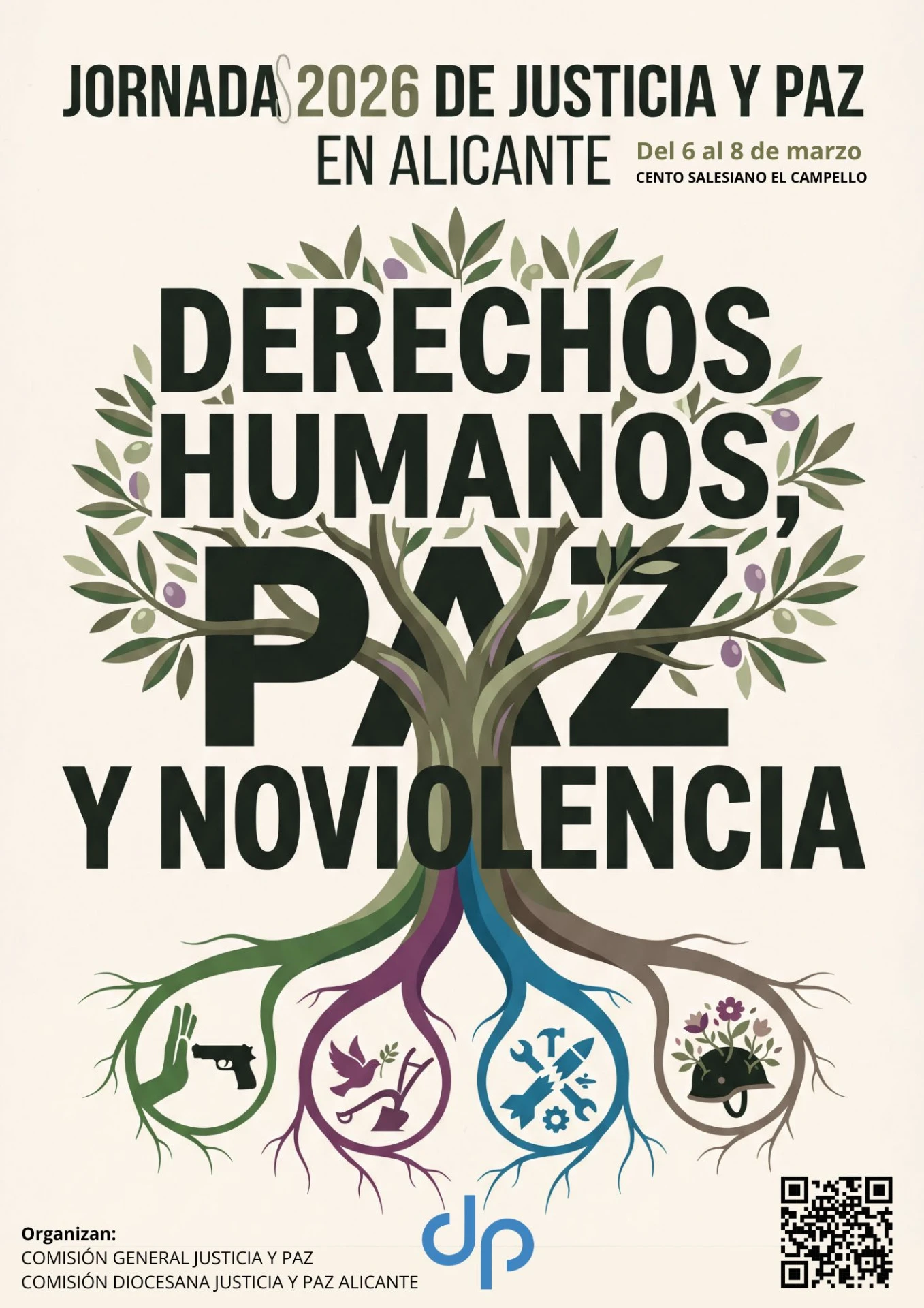
Justice and Peace of Spain advocates active nonviolence to build an “unarmed and disarming” peace
After three days of meetings, reflection, and dialogue on the present and future of peace, the conference "Human Rights, Peace, and Nonviolence" organized by the Spanish Commission for Justice and Peace in conjunction with the Diocesan Commission for Justice and Peace of Orihuela-Alicante concluded with a commitment to the active nonviolence of the Gospel as the path to building a just and lasting peace, unarmed and disarming (Pope Leo XIV).
The meeting, held from March 6 to 8 in El Campello (Alicante) and attended by José Ignacio Munilla, bishop of the diocese of Orihuela-Alicante -Alicante, and Javier Vilanova, accompanying bishop of Justice and Peace, brought together the diocesan Justice and Peace commissions in the country along with experts, activists, and artists committed to social justice and peace to reflect on the theme "Human rights, peace, and nonviolence"in a particularly troubling international context.
We are living in a time marked by an increase in armed conflicts, a rise in military spending [1], the erosion of fundamental rights in various regions of the world, and the weakening of multilateral structures and international human rights law. This trend reflects a growing militarization of international relations that fuels a logic of confrontation and fear.
The genocide in Gaza, the open wars in Ukraine and the Middle East, the persistent conflicts in Somalia and Sudan, the situation in Myanmar, and many other realities of structural violence and injustice reveal a global ecosystem of war that intrudes into the daily lives of individuals, families, and societies with economic, social, cultural, and ecological violence that particularly affects the most vulnerable populations.
One of the central messages that emerged from these conferences is that history is not predetermined or doomed to repeat cycles of violence. Human decisions, both personal and collective, can open up different paths. Against this backdrop, Hope reveals itself as a historical force capable of mobilizing consciences, transforming structures, and sustaining processes of social change.
In the face of the logic of polarization, armament, and violence, the conference reaffirmed that active nonviolence must be the response of Christian communities to the conflicts and injustices of the world. This response, far from being a passive or resigned attitude, constitutes an active, creative, and comprehensive way of dealing with conflicts. Active nonviolence involves resisting evil without reproducing its logic, defending human dignity without destroying the adversary, and transforming unjust structures through truth, justice, solidarity, and love.
In this sense, the conference sought to be a space for discernment, formation, and hope, where participants could critically analyze reality and seek answers based on faith and a commitment to building a just peace. Representatives from the Catholic Institute for Nonviolence of Pax Christi International, the Delàs Center for Peace Studies, the Regional Institute for the Study and Practice of Strategic Nonviolent Action in the Americas, NOVACT, and the Christian Nonviolence Group of Cristianisme i Justícia.
Experiences of social transformation from different contexts and specific testimonies of active nonviolence were also shared, such as those of the El Arca community, the anti-militarist group Tortuga, the conscientious objection movement, and the Nonviolence Collective. These experiences show that active nonviolence can be embodied in everyday practices of resistance, reconciliation, action, and prophetic denunciation.
The conference also addressed spiritual, theological, ethical, and strategic dimensions of nonviolence, reflecting on tools such as defense and nonviolent civil disobedience, tax resistance to military spending, civil resistance, nonviolent direct action, mediation, dialogue, and diplomacy from a comprehensive perspective in the service of human dignity and justice. All of these are part of a set of practices that allow conflicts to be addressed without resorting to violence and war, which have historically proven to be more effective than these in numerous processes of social transformation.
Inspired by the Gospel and the Social Doctrine of the Church, the participants in the conference reaffirmed that peace cannot be built on the logic of fear and lies, but rather on an "unarmed and disarming peace" that calls for justice, truth, and the abolition of war as a means of resolving conflicts.
The Church has a significant role to play in this process. Beyond mere declarations, the ecclesial community has an extensive network of communities, institutions, and meeting places that can become spaces of peace committed to active nonviolence. The Church has a responsibility to help Organize Hope, to articulate mediation, educational, community, and social processes that strengthen a culture of active nonviolence and the defense of human rights.
For this reason, the conference concluded with a call to promote active nonviolence as a path to personal, cultural, social, and political transformation, to strengthen the defense of human rights in the face of all forms of violence, exclusion, or injustice, to promote a culture of peace that places the dignity of each person and care for our common home at the center, and to weave networks between Christian communities, social movements, and organizations committed to the practice of active nonviolence.
At Justicia y Paz, we feel called to awaken consciences, nurture hope, and actively commit ourselves to building peace. The nonviolence that emanates from the Gospel is a transformative force capable of opening new paths amid the violence of the world. We reaffirm that peace is a common task. It begins in each person and in each community, in every daily gesture of justice and fraternity, but also in social, cultural, and political commitment to a disarmed and disarming peace. Because, as we have been reminded throughout these days, history remains open and it is possible to build a different future when hope turns into collective action.
Finally On this March 8, when International Women's Day is celebrated, Justice and Peace wishes to highlight its presence in the construction of dialogue, encounter, community, and peace. It also wishes to highlight the role of so many women throughout history who have not resigned themselves to playing a subordinate role in politics, society, and the church, defending human rights.
Spanish Commission for Justice and Peace
[1] In 2024, global military spending increased by 9.4% compared with the previous year, confirming an uninterrupted trend over the past ten years and reaching the figure of 2.718 trillion dollars, that is, 2.5% of global GDP. (Data from SIPRI – the Stockholm International Peace Research Institute – cited in the Message for the 2026 World Day of Peace).